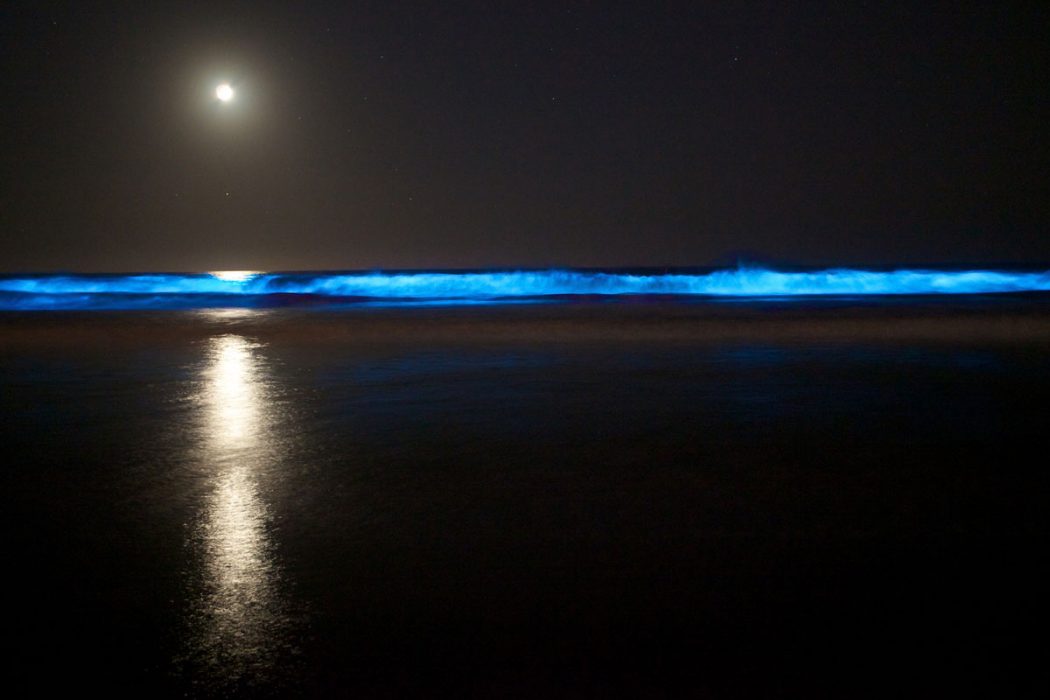
“It’s like taking a stroll downtown at night,” said our instructor, Don. “Everybody is out — a really wild time.” Waving his arms in animated motion, he proceeds to describe the reef-city after dark. “You’ve got corals and tubeworms dancing to the tune of the tides, tentacles swaying in the gentle current. A parrotfish is curled up on the corner in its translucent sack, trying to sleep it off, while gangs of crustaceans cruise the dark corners of the reef’s back streets. And the city lights are a thing of beauty — a soft glow of bioluminescent algae and comb jellies. But like taking a stroll through the city at night,” he warns, “you’ve got to be careful, take precautions. After all, it’s a different world down there at night.”
When you first hear about night diving, that’s the focus — the difference in the marine life at night. But how about us, the divers? Are we different, too? At first blush, night diving might not seem like such a big deal. It’s dark, so we use dive lights. No problem, right? But nothing is that simple in diving.
In reality, some very important differences distinguish day from night diving. Diving at night introduces an entirely new regime of human factors considerations that affect our physiological, psychological and biomechanical adaptation to the underwater environment. By understanding these human factors considerations, we can improve our aquatic decision-making and safety in the water after dark.
Aquatic Decision Making
At the core of our ability to dive safely is our judgment and decision-making ability. To exercise good judgment and make safe aquatic decisions requires a continuous assessment of three vital factors: the environment, our equipment, and our own abilities and limits. Training and experience are key elements in making these assessments, but our experience and training in daytime diving does not necessarily prepare us for a night excursion under the waves. Each of these factors takes on new dimensions as daylight fades and shadows grow longer. Water conditions and diving environments considered within our abilities for a day dive become much more difficult to negotiate at night. Our familiarity with our equipment becomes more critical when diving in darkness, and additional equipment is needed to ensure proper vision, communication and navigation, both underwater and on the surface. Finally, our own abilities and limits vary much like the daily cycles of day and night.
The Rhythm of the Night
One of the first implications in night diving is the effect of our circadian rhythms, our daily sleep-wake cycles that alter our states of consciousness. Body temperatures, blood pressure, stress hormones, digestive secretions and mental alertness all follow a daily pattern that resets itself according to daily cycles of sunlight and darkness. Of these, mental alertness may well be the most important to a diver, as it affects our decision-making ability.
According to experts in the field of circadian science, a person rising at 7:30 a.m. with adequate sleep will experience peak alertness levels in the morning around 8 to 9, and again in the evening between 7 and 9. (See Figure 1.) Alertness drops to a lower level from about 12 noon to 3 p.m. and drops off rapidly after 9 p.m. Based on this data, divers can generally expect reduced mental alertness on a night dive. The excitement of a night dive might conspire to artificially elevate mental alertness, but other factors, including acute and chronic fatigue, may also come into play.
The effects of fatigue on human performance have long been known and understood. Acute or short-term fatigue is the tiredness experienced after long periods of physical or mental strain. Work, study, travel, lack of sleep and physical exercise can induce episodes of acute fatigue. The symptoms include reduced coordination and impaired alertness, both of which can be problems for divers. If a diver works, plays or parties too hard over a period of several days, the effects of acute fatigue can significantly degrade his or her performance and safety on a dive.
To illustrate the importance of mental alertness, consider the fact that 32 percent of marine accidents occur between the hours of 4 a.m. and 8 a.m. It’s also interesting to note that four of the worst industrial accidents in recent history involved impaired judgment caused by fatigue. The Chernobyl and Three Mile Island nuclear power plant accidents, the grounding of the Exxon Valdez off the coast of Alaska and the Bhopal, India, chemical plant leak all occurred between midnight and 5 a.m. — a period when mental alertness is at its lowest.


One approach to minimizing the effects of reduced mental alertness is to carefully plan and prepare for night dives. By making night dives relatively simple and conducting them in low-risk environments, we can also reduce the potential for problems.
Circadian rhythms and fatigue aren’t the only human factors challenges faced by night divers. Night diving also presents a number of physiological and biomechanical considerations, including nutrition, night vision adaptation, heat balance and increased task loading.
Nutrition: A Diet for Night Diving
Nutrition is an important consideration for divers regardless of when they dive, but nutritional strategy is particularly important at night, when we strive to overcome the effects of circadian rhythms and fatigue. Scientists and nutritionists have learned that good nutrition and eating habits play an important role in mental performance. The types of foods eaten and the sequence in which they are consumed have a marked impact on our state of mind, mental alertness and reflexes.
Chemical neurotransmitters derived from the foods we eat help transmit messages to the brain, causing a response in terms of mental acuity and activity. Seratonin, a chemical neurotransmitter derived from carbohydrates, tends to have a calming, relaxing effect on mental activity. While this can help reduce stress, too much of a good thing can be bad. A high-carbohydrate meal consisting of pasta, crepes, potatoes, starchy vegetables and sweets can increase seratonin levels enough to induce not just a pleasant feeling, but lethargy and the need to sleep. Likewise, fats tend to prolong digestion and rob the brain of blood to aid in the digestion process. The result is fatigue, sleepiness and overall lack of alertness.
Alternatively, a meal that begins with high-protein foods, such as steak, eggs and high-protein cereals and is relatively low in carbohydrates and fat, will help promote mental alertness. Dopamine and norepinephrine, derived from protein in our food, stimulate the brain to higher levels of alertness and activity.
Most divers are savvy enough to avoid alcohol prior to a night dive. Alcohol affects both the central nervous system and the circulatory system in ways that can erode the margin of safety when diving. Even a small amount of alcohol can degrade mental acuity, increase heat loss and predispose a diver to decompression illness. (See sidebar.) When planning a dive after dark, it’s best to stay away from the bar.
Night Vision Adaptation: Seeing Isn’t Always Believing
As most divers would agree, the most obvious difference between a day dive and night dive is our inability to see as well at night. Ambient lighting in daylight allows us to see clearly, and our peripheral vision is limited only by the physical constraints of our mask. At night, our vision is limited by the beam of our dive light. This tends to focus our attention on a relatively small area of the submarine world, but it has other consequences as well.
Surprisingly, we can often see significantly more than we might expect even without the aid of a dive light, although vision at night without artificial light may not be quite so clear. The retina of the human eye has two types of receptors, referred to as cones and rods. The cones are located in the central area of the retina and provide clear, focused vision in well-lighted conditions. The rods, located in the area surrounding the cones, see less clearly, but more readily adapt to dark lighting conditions. “For more information, see “Understanding and Equipping for Underwater Vision” in the June 2000 issue.”
Our best night vision develops after a period of exposure to low lighting, a process called dark adaptation. This can take as long as 30 minutes for total adaptation to blackness, but 20 minutes in dim red lighting will provide a moderate degree of adaptation. Dark adaptation is impaired by the carbon monoxide present in cigarette smoke, or a dive boat or compressor exhaust.
Even a brief exposure to white lights will require a lengthy adaptation process to restore night vision, so be careful not to shine a dive light in another diver’s eyes. Night vision may also be impaired for some time after submerging from a brightly lit environment.
Reduced visual perception can manifest additional problems on a night dive. Pilots have long been taught that various visual illusions, disorientation and vertigo can occur in a darkened environment. The sense of balance and motion is derived from several sources, including visual references and the intricate mechanisms of the inner ear. Normally, the brain compares inputs from various senses to determine orientation and movement.
Without all the necessary information, the brain can become confused, causing the individual to take inappropriate actions. For example, certain accelerations caused by rapid head movement, turbulence or changes in aircraft orientation combined with limited visual references can induce spatial disorientation or vertigo in pilots. If unaware of the problem, a pilot might put his aircraft in a dangerous position while attempting to rectify an incorrectly perceived problem. In these situations, pilots must rely on the aircraft instruments to determine the orientation and true motion of the aircraft. A failure to rely on or properly interpret flight instruments combined with the lack of visual references can cause a pilot to fly a perfectly good airplane into the ground.
For divers, a lack of visual references combined with rapid head movements, currents or surge can also create false perceptions of motion and orientation. Head-first descents in dark or limited-visibility water, even with a dive light, can result in disorientation and vertigo. (See sidebar.) When the beam of our dive light is scattered or reflected during a rapid descent, the effect can be similar to driving at night in a blinding snowstorm, and disorientation and vertigo can result. To reduce the effect, make a slow, controlled, feet-first descent when diving from a boat or in open water. Following a descent line or anchor line and monitoring a depth gauge or computer during the descent virtually eliminates the vertigo and disorientation.
Perhaps more importantly, a lack of visual references on the ascent can lead to disorientation and excessive ascent rates. Again, avoiding this problem on a night dive is relatively simple. On a shore dive, we can maintain contact with the bottom throughout a gradual, controlled ascent. When diving from a boat or surfacing in open water, a good option is to use an ascent line and closely monitor the depth gauge or dive computer to maintain a proper ascent rate.
What’s Hot and Who’s Not
While the water temperature might in fact be the same day or night, several factors tend to increase our heat loss on a night dive. The air temperature is likely to be lower at night than during the day, possibly leading to greater heat loss prior to and following a night dive. In addition, we have no sun to warm us before, between and after night dives.
It’s not unusual to begin a night dive with a heat deficit from the day’s diving, particularly if we haven’t taken the time to get the proper rest, warmth and nutrition following the day’s diving. Experts warn us that it is quite possible to “feel” warm, even if our core temperature is reduced.
In his book Deeper into Diving, author and lecturer John Lippmann states, “Divers often disregard cumulative effects of repetitive diving. After the initial dive, the diver might experience superficial skin warming and thus feel warmer. However, his core temperature may still be reduced. Feeling warm is no guarantee that your heat losses have been replaced. The best way to show that your heat losses have been replaced is to start sweating. This shows the body needs to lose heat.”
Don’t make the mistake of considering heat loss merely a matter of comfort. As with nutrition and fatigue, body temperature has a direct effect on mental processes. If body temperature decreases significantly, judgment might be jeopardized. In addition, breathing rate may increase in response to cold, causing a diver to consume air reserves more quickly.
“Cold-induced mental changes are probably the danger to the diver,” writes Lippmann, “because once the brain does not work properly, wrong decisions can easily be made. Some authorities believe that long, slow cooling of the body does not stimulate shivering and the subsequent heat regeneration. As a result, the diver might not notice the heat drain from his body until significant hypothermia has developed and shivering finally occurs. Some consider this ‘silent hypothermia’ to be the major hazard to the diver in cold water, as it will make the diver more accident-prone without him being aware of it.”
The take-home message for night divers is to minimize heat loss. Precautions against heat loss may include wearing extra exposure protection on all dives prior to a night dive, even in warm waters. We can limit our cold exposure prior to night dives by limiting bottom time and depth. Limiting bottom time reduces the period during which the heat loss is high, and limiting depth minimizes the compression of the exposure suit, thus improving its performance. Changing into warm, dry clothing between dives can reduce evaporative cooling.
Task Loading and the One-Handed Diver
Beyond the physiological considerations of a night dive, we must also contend with a basic biomechanical handicap. The simple act of using a hand-held dive light means that we have only one free hand. Buoyancy control, ear clearing and communications must be accomplished “single-handed.” While not necessarily a problem, the difficulty can increase dramatically when towing a surface float or manipulating other accessory equipment.
The single-hand limitation can become a significant handicap, even when contending with relatively minor equipment problems. As Dr. Glen Egstrom, Professor Emeritus UCLA Department of Physiological Sciences, explains, “We typically use one hand to hold the dive light, and this becomes a problem in an emergency situation. If we drop the light so we can deal with the problem two-handed, we can no longer see.”
RELATED READ: TIPS FOR USING A DIVE LIGHT
Choosing a dive light with the proper characteristics can help solve the problem. The proper buoyancy, size and handle design may make a dive light easier to use, and thus ease the task loading associated with a night dive. Some divers find that a wrist-mounted or head-mounted light reduces the workload and makes night diving easier. Another way to cope with the problem of increased task loading during a night dive is to closely coordinate tasks with your buddy.
The Psychology of Night Diving
Divers are drawn to night diving like moths to a porch light, and there’s really little surprise. Just the thought of venturing into the water at night can make your skin tingle with excitement. Entering a world illuminated only by a dive light, our attention is drawn to a sharp point of focus, and we find ourselves seeing the underwater world as if for the first time. “We have an entirely different psychological set at night,” notes Egstrom. “First, there’s a peripheral narrowing that occurs as we increase the psychological stress. It becomes a more introverted dive, and this is actually something that people enjoy. The dive takes up more of our cognitive energy.”
Indeed, there are stresses associated with a night dive. Perhaps the most obvious is the psychological stress of facing the unknown, and this can last from the planning phase throughout the entire dive. If we’re unfamiliar with the area, night diving procedures or the nature of marine life that might be encountered, our stress levels are certain to be heightened. Add unfamiliar equipment, a new or different buddy, or any other factors, and our baseline stress for a night dive can be significant.
While a low level of stress when diving can be helpful in focusing our attention on the situation at hand, too much stress can spell trouble. As stress increases further, our ability to maintain situational awareness decreases, degrading our ability to make the assessments necessary for safe, competent decision making. Increased stress may also translate to increased breathing rate, making air reserves a more critical consideration.
A number of situations that bump up our stress level quite abruptly can arise on night dives, especially if we’re unprepared. One of the thrills of night diving is having unexpected sea creatures suddenly loom out of the darkness. But sometimes this surprise factor creates a momentary heightening of anxiety and stress. A minor equipment problem or disorientation can also spike the stress level until the situation is resolved.
The flip side to the enjoyable, introverted dive is a reduced situational awareness that erodes our decision-making ability. As Egstrom explains, “Since the peripheral visual field contracts during periods of increased stress, we lose a lot of information we might otherwise have.” Sometimes divers become so engrossed with their surroundings at night that they fail to closely monitor their depth or air consumption.
The real problem comes when a situation begins to run awry. “At night, we might not be as likely to see a problem developing,” suggests Egstrom. “So this narrowing of focus can be a problem when it comes to our buddy.” If a situation is left unchecked, a full-blown emergency can develop, throwing divers into a dangerous spiral that runs out of control. An emergency that arises during the course of a night dive can elevate stress beyond the levels expected for a similar scenario in daylight. For example, a low-air or out-of-air situation may be more stressful at night due to the difficulty of resolving the problem in darkness. The net result may be an inability to successfully complete the necessary task.
For this reason, divers must focus on situational awareness and keep tabs on their buddy during a night dive. By staying in a fixed position relative to one another, divers are less apt to become separated and can communicate more readily. By following such a protocol, the stresses that might develop can be minimized, and the potential for problems is greatly diminished.
Training and Fitness
The real keys to safe and enjoyable night diving are training and fitness. Proper training in night diving skills and procedures, combined with a regular program of fitness, form perhaps the best strategy for mitigating any negative human factors considerations associated with night diving.
Night diver training focuses sharply on the night environment, skills, and the planning and preparation needed to safely conduct a night dive. All these topics are covered in a night diving specialty course. The more we know about night diving and the environment in which we’re diving, the more confidence we have in our abilities to dive safely. This confidence helps shield us against the effects of psychological stress.
Proper planning and preparation go a long way toward avoiding disorientation, vertigo and potential emergencies. Start by preparing a detailed emergency procedures plan and review the elements of this plan before entering the water. The emergency plan should consider such contingencies as low air, out of air, entanglement, missing buddy, disorientation, failed dive light(s) and other typical equipment problems.
To compensate for reduced mental alertness and the obvious difficulties of working in darkness, our strategy should be to prepare as much of our gear as practical during daylight hours, when our mind is alert and it’s easier to spot problems. This leaves only the process of suiting up and completing the necessary checks and safety briefings to be done prior to entering the water.
When an unplanned situation arises on a night dive, our response should be to stop, relax, breathe normally and follow the established procedures developed as part of the predive planning. If the situation lies beyond the established emergency plan, we must think rationally and communicate before launching into an action that might be unsafe.
A critical aspect of night diver training is practicing the requisite emergency skills and drills in a darkened environment. The need and use of dive light, and the potential need to resolve a problem in near total darkness, often adds greater complexity to underwater emergency management and requires additional practice to master.
Handling a night diving emergency on the surface can be nearly as difficult as in the water. Hillary Viders is an international expert in emergency dive accident management who teaches Emergency Oxygen Administration and Dive Accident Management programs for the scuba, rescue and law enforcement industries. “When I teach professional rescuers,” explains Viders, “I conduct a timed drill in which each team of four people has to assemble a complete oxygen kit from a pile of assorted components while administering CPR on an ‘unconscious’ victim. Usually a professional team (one that handles oxygen equipment and performs these tasks several times every day) can complete the drill in under 60 seconds. However, when I ask the same team to repeat the identical drill in a completely darkened room, it usually takes the best group at least five times longer, and some teams cannot do it correctly at all!”
Viders’ experience underscores the need for thorough training and preparation in all aspects of night diving. Not only must in-water skills be practiced in the dark, but skills required to effectively manage a diving emergency must also be practiced under cover of darkness.
Good physical conditioning reduces the effort required to complete a dive, thus reducing the psychological stress. A high degree of fitness also allows us to perform better and for sustained periods when problems arise and during an emergency.
The Bottom Line
There’s nothing like taking that stroll down through the reef-city at night. But just like taking an evening stroll through our land-based cities, we need to be wary and take the necessary precautions. With thorough training and preparation, we can overcome most of the human factors problems and safely enter a spectacular underwater world almost beyond imagination. “It’s magic,” says Don. “Just magic.”
The Effects of Alcohol on Divers
All divers should know that diving and alcohol simply don’t mix. Consumption of alcohol has the following effects on divers.
- Alcohol adversely affects the central nervous system. Studies have shown that as little as 1 ounce of liquor, one bottle of beer or 4 ounces of wine can degrade motor skills and impair judgment, and will be evident in the breath and blood for a period of at least three hours. There is evidence that alcohol also impairs sleep, leaving us less rested after a night’s sleep. Fatigue reduces mental alertness and decision-making ability long after the direct effects of alcohol subside.
- Alcohol alters the diver’s circulation. Alcohol tends to increase circulation to the surface of the skin while reducing circulation to the tissues. The result is an increase in heat loss, as well as an increased predisposition to DCS.
- Alcohol is a diuretic and tends to dehydrate a diver. Dehydration reduces the blood’s capacity to off-gas nitrogen, since blood flow is reduced throughout the tissues, thus increasing the risk of DCS.
- Alcohol alters the blood chemistry, which may increase the growth of microbubbles, thus leading to DCS. Researchers also have found that drinking increases oxygen consumption in the heart and other muscles during periods of exercise, so drinking may actually increase air consumption.
RELATED READ: ALCOHOL, NICOTINE & DIVERS – WHAT YOU SHOULD KNOW
Avoiding Vertigo and Disorientation at Night
Vertigo is a condition in which a diver perceives motion but is unable to determine the direction or speed of movement. Vertigo can cause disorientation, dizziness and even nausea. A number of factors can induce vertigo in a diver. Cold water entering the external ear canal can induce a condition of imbalance leading to vertigo. The condition may last until the diver’s body has warmed the water. Pressure imbalances between the left and right ear during descent can also cause vertigo. Disorientation and vertigo can occur at night, when a diver has no visual references to determine orientation or motion.
Divers can often overcome the effects of disorientation and vertigo by following standard procedures at the onset of the condition. As with all problems and potential emergencies that arise underwater, divers must remember to stop, breathe, think, then act. When disorientation occurs, refer to your compass and depth gauge to reorient yourself. Holding onto one’s self or buddy until the vertigo passes can also be helpful. Remember, too, that bubbles go up. Shine your dive light to illuminate your bubbles as an additional reference. If you can’t see your bubbles, put your hand near your regulator exhaust and feel their direction of movement.
Effects of Low Body Core Temperature/Hypothermia
98.6˚F (37˚C)
Normal temperature
95 – 98.6˚F (35 – 37˚C)
Sensation of cold, increased heart rate, shivering, vasoconstriction, slight incoordination in hand movements, urge to urinate.
90 – 95˚F (32.2 – 35˚C)
Increased muscular incoordination, slurred speech, decreased or loss of shivering, weakness, apathy, drowsiness, confusion, impairment of rational thought.
85 – 90˚F (29.4 – 32.2˚C)
Loss of shivering, confusion progressing to coma, inability to follow commands, inappropriate behavior, loss of vision, temporary amnesia may occur, cardiac irregularities may develop.
Night Diving Planning and Precautions
Night diving isn’t unduly complicated, but it does require a modicum of training beyond basic open-water diving. Before attempting a night dive, be certain to receive the proper training. The following planning tips and precautions can help make your night diving safer and more enjoyable.
- Always evaluate a dive site in daylight before attempting a night dive. The evaluation should include, but not be limited to: safe entry and exit locations, potential hazards (including entanglements), currents, navigation features and forecast weather conditions. Familiarity with the dive site reduces the psychological stress of a night dive, allowing divers to better focus on other safety concerns throughout the dive. Consider planning a dusk-to-night dive; enter the water while there’s still some light out, and you can gradually adjust to increasing darkness underwater.
- Avoid night diving in conditions of foul weather (including forecast fog or heavy rain), high seas, strong surf, strong currents or unreasonable entanglement hazards. Such conditions pose an unnecessary risk to diver safety. Also, avoid overhead environments, including kelp, at night until you accumulate the requisite experience to do so safely.
- Enjoy a good meal prior to a night dive, but avoid consumption of alcohol.
- Don’t dive unless you’re well-rested and warm. If necessary, limit your daytime diving in order to be better prepared for a night diving excursion. An afternoon nap, even if it’s only 15 to 20 minutes long, may leave you feeling more rested and improve your alertness for a night dive. Mild exercise can help restore the heat deficit from daytime diving.
- Proper site preparation is key to all night dives. Surface navigation lights, working lights, emergency first aid equipment, communication equipment and rescue gear should all be properly set up prior to entering the water. Always have at least one person remaining at the surface or on the boat to deal with problems such as failed surface navigation lights and dragging anchors. This individual should also be prepared to deal with emergencies and call for assistance if necessary.
- Always begin a night dive with at least two dive lights per diver. If a dive light fails, the dive can be safely completed and terminated with the extra light. For hands-free night diving, consider using a wrist-mounted or head-mounted dive light as a primary dive light.
- While night diving emergencies are part of every night dive plan, few divers actually practice emergency procedures at night. To keep your skills sharp, confidence high and stress reduced, practice night diving emergency skills regularly. Many skills can be accomplished in a pool, and others can be practiced safely in open water. If you haven’t practiced night emergency skills in the open water lately, have an instructor guide you through the proper exercises.
By Robert N. Rossier