
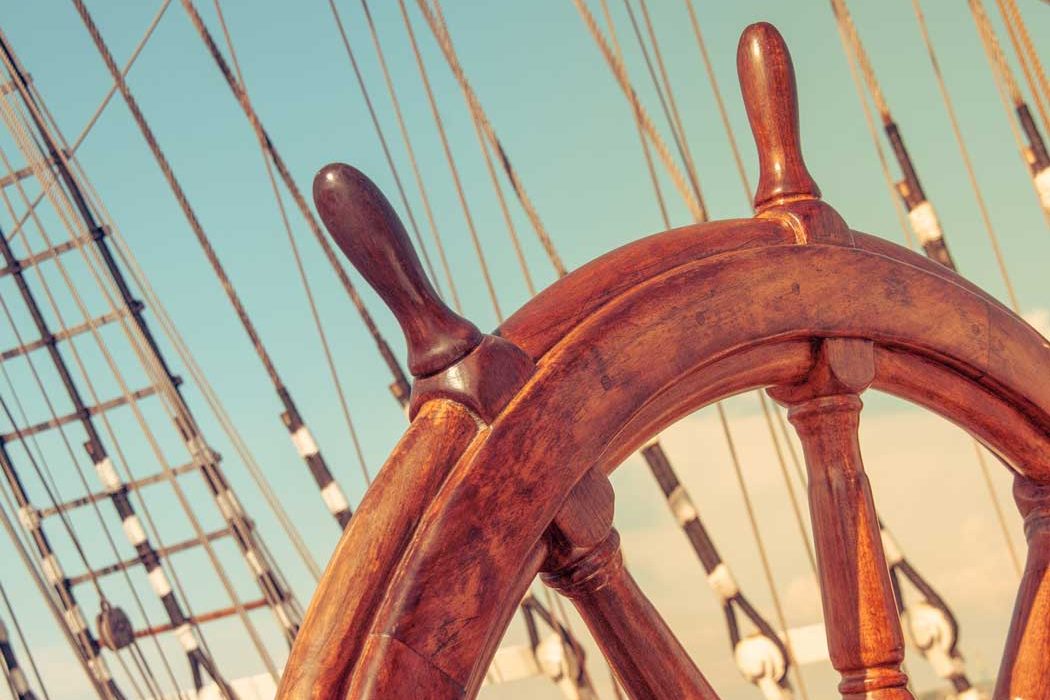
You are a 19th-century mariner, living in the dank, dark quarters of a sailing ship, at the mercy of capricious wind and weather, six weeks from your last sighting of land. There is no marine weather forecast, no radio, no satellite communication; in fact no communication with the world as you knew it for periods ranging from months to years. You are virtually isolated from the rest of humanity. The captain is the absolute dictator; the ship is his kingdom. You and the rest of the crew are serfs. Small wonder that you grasp at any support you can, whether real or imaginary.
Even today, any endeavor based on chance is predisposed to superstition, ranging from poker to baseball. A hitter on a hot streak may not wash his socks or undershirt, or will eat the same breakfast every day as long as he keeps getting on base. Pitchers won’t step on the foul line coming off the field, and woe to anybody who dares mention a no-hitter while the game is in progress.
Going to sea then was chancier than going into outer space today, so a mariner’s life was rife with superstitions. Some superstitions may have had a tenuous basis in fact, but most were contrived beliefs and rituals that sailors relied upon to give them a feeling that, to some small extent, they had some control over their destiny.
For example, it is considered unlucky to begin a voyage on Friday. That’s considered an unlucky day on land as well, probably because it was the day of the crucifixion. There’s a tale often told, almost certainly apocryphal, about the British navy’s attempt to lay that superstition to rest. According to legend, the ship’s keel was laid on Friday, it was launched on Friday, and christened the HMS Friday. Its captain’s name was Friday, and it set sail for her maiden voyage on … you guessed it … Friday. The last time anybody ever saw it or the crew was when it disappeared over the horizon. Although the story has about as much credibility as an Internet hoax, it vividly illustrates the power of superstition.
Many superstitions about the sea survive to this day. Curiously, they haven’t extended to scuba diving. Maybe it’s because diving is securely grounded in fact, and it didn’t get started among the general populace until the mid-20th century. Rituals like spitting in a mask or backing off the valve a quarter turn are based on science and education. Yet talk long enough to a diver, and something may come up that defies logic.
I’ll have to admit to one such practice. About 20 years ago I was spending an entire summer in the Red Sea, working on my first book. I lost my towel and needed a substitute, so I bought the cheapest and ugliest one I could find, figuring nobody would ever pick it up by mistake. It was a horrible hodgepodge of pink, green, and yellow pastels depicting palm trees, sailboats, and domed desert dwellings. It found a home at the bottom of the cooler that held my camera gear. As the years went by, I began to refer to it as my lucky towel. It was more ritual than superstition, but I believed that as long as the towel was in the cooler, my camera wouldn’t flood.
That belief was put to the test when I failed to tighten a screw on my housing and flooded a Nikon N90, destroying it. But I wrote it off to pilot error, rationalizing that the towel wasn’t to blame; it was totally my fault. I still have my lucky towel and take it on every dive trip, whether it’s one day off the coast of San Diego or several weeks halfway around the world.
By and large, divers are a pragmatic lot and none of the ones I surveyed admitted to any superstitions. There are a few rituals. One diver won’t leave the dock without his lucky hat. Another diver carries a copy of the dive tables along with two computers. Although she is aware that a failed computer dive can’t be carried over to the tables, those plastic tables are comforting to her.

When it comes to superstition, though, divers are bush leaguers compared with sailors and fishermen. A few beliefs are based on a semblance of fact, but the majority have no rhyme or reason. Since divers spend so much time aboard boats it might be fun to examine some of them.
Salted Nets Catch Fish
Among today’s seafarers, fishers are the leaders in the superstition department. Even with GPS and sensitive fathometers, catching those critters is still a matter of luck. They have some bizarre beliefs. If they see a red-haired person on the way to the boat it’s bad luck. Other bad omens include a black valise, a minister and a cross-eyed or flat-footed person. A fisher whose finger is stuck by a fishhook will stick the hook into a piece of wood to speed the healing process.
Don’t bring bananas on board, or you won’t catch any fish. And empty your pockets of pennies before boarding or your catch will be small. Don’t eat anything before the first fish is caught, and the first one caught each day must be spit upon and thrown back. Never count your fish until the day is over. And never tell anybody where you made a good catch. That’s got a practical basis. If your livelihood depends on catching fish, you don’t want others parasitizing your secret spot, especially if they have access to GPS coordinates.
Nets were “salted in” at the beginning of the season to bring good luck. This often took the form of a blessing, and sprinkling them with salt. Fishing every day of the week was considered unlucky. Those who did it were greedy, and not satisfied with what the gods of the ocean provided them.
Harbingers of Doom
Flowers are for funerals, and therefore weren’t welcomed aboard ship. If somebody’s sweetheart brought some aboard as a bon voyage gift, they were quickly thrown overboard. Clergy weren’t welcomed either, for the same connection with funerals, but they weren’t tossed off the ship.
Sharks following a ship were thought to be a portent of death. In most cases, they were probably waiting for the remnants of the day’s meal. I once had a dive buddy named Crazy John. He had a .22-caliber rifle and tried to shoot blue sharks on the surface “…before they get me.” That’s no longer a factor because gill nets have virtually wiped out blue sharks in California coastal waters. I stopped diving with Crazy John after looking into the business end of his loaded spear gun once too often.
If somebody died aboard ship, the body was tossed overboard with an appropriate ceremony for burial at sea. Usually the sailmaker would make a shroud and sew the body in, making the last stitch through the victim’s nose. This was the final assurance that they were indeed dead, assuming the needle would elicit a scream of pain from an unconscious or near-dead victim. It was considered bad luck to keep a corpse on board, and in the days before adequate refrigeration, the reason was more than mere superstition. By the same token, an empty coffin on board meant that a member of the ship’s crew would eventually be filling it.
Sailors had a fatalistic view of drowning. Most of them couldn’t swim, so even bathing in the ocean was considered a dangerous temptation of fate. The object of survival was staying out of the water, so nobody went in unnecessarily. If someone fell overboard, they might not even be thrown a rope because of the belief that their death was already preordained. “What the sea wants, the sea will have,” was a fatalistic belief. Besides, a sacrifice to the sea gods might placate them so no more of the crew would follow.
The ringing of bells is also associated with funerals, so sounds mimicking bells were thought to forecast death. The ringing of a wine glass was such a sound, and had to be stopped before its reverberation ended. Ship’s bells were exempted from this superstition, because they signaled time and the changing of watch duties. But if they rang of their own accord, as in a storm, somebody was going to die.
The tides were thought to have an effect on death. If someone was gravely ill or wounded, death would come on ebb tide, as though life were ebbing away.
A Jonah was a person or a ship or anything that brought bad luck. The name, of course, originates from the biblical tale of Jonah, a prophet who was sent by God to the sinful city of Nineveh to try to restore order. He chickened out and boarded a ship headed in the opposite direction. A series of violent storms attacked the ship, and when the crew discovered Jonah’s deceit, they threw him overboard and he was swallowed by a “great fish,” which has come to mean a whale. The storms abated, and after a couple of days, the whale regurgitated Jonah and he was rescued. Having learned his lesson, he immediately headed for Nineveh to carry out his mission.
A Jonah could be a sailor whose last ship had bad luck, an unlucky ship, or even an unlucky object like a black valise. The offending person or object would be sent off the ship at the first opportunity.
Birds were thought to carry the souls of dead sailors. Killing a dolphin, a gull, or an albatross brings bad luck. The albatross story was immortalized in Coleridge’s “Rime of the Ancient Mariner,” in which a sailor killed the bird and was dogged by tragedy and misfortune.
Stepping aboard a ship with your left foot first, or losing a bucket overboard, or seeing rats leaving the ship brings bad luck. It is lucky to have tattoos, to have a black cat on board, to throw a pair of old shoes overboard, and to have a child born on the ship (which conflicts with the prohibitions against women).
The words “drown” and “pig” were bad luck. So was swearing while fishing. A hatch or a basin placed upside down represented a sinking ship. And dropping a hatch into the hold meant even worse misfortune.
Davey Jones’ Locker was the mariner’s version of hell where the devil held sway among sunken ships, souls of dead sailors, and anything that fell overboard. Davey’s surname is thought to be a corruption of Jonah. Fiddler’s Green, also located beneath the sea, was a sailor’s heaven where winsome, willing wenches danced to merry fiddlers’ tunes while grog and beer flowed freely from bottomless jugs.
Whistling Up the Wind
Because weather deeply affected ships during the age of sail, there were more superstitions about that factor than any other. I discussed some of them with Al Sorkin, an instructor at the San Diego maritime museum and an experienced blue water sailor.
“Red sky in the morning, sailor take warning. Red sky at night, sailor’s delight.” That’s probably the best-known weather prediction rhyme, and it has some basis in fact. The saying originated in England, where weather conditions come from the ocean to the west. If the air is clear, sunset will be tinted red. In the morning, red light will be reflected by clouds to the west, which means moisture in the air and possible storms.
“Rain at seven means fine by eleven.” Rainy days usually consist of a series of showers, seldom lasting more than four hours. This is especially true of heavy rainfall.
A ring around the moon meant rain was coming. The ring is caused by ice crystals in the upper atmosphere, and that meant moisture, which could evolve into rain.
Many other weather superstitions had no factual basis. Clapping aboard ship was thought to bring thunder. Umbrellas are for foul weather use, and bringing one on board was thought to tempt fate. Throwing stones into the sea caused storms and huge swells. But a horseshoe nailed to the mast provided protection from storms. Whistling was supposed to bring a breeze, so becalmed sailors must have done a lot of it.
Oil on troubled waters was thought to keep waves from breaking. To a certain extent it helps, but it takes a lot more oil than sailing ships carried to make any difference. They usually made a token offering of a few drops, along with heartfelt incantations to the sea gods.
Women on the Water
Nowhere are there more conflicting maritime superstitions than with the subject of women on board. Women weren’t welcomed aboard ship, except in port when the sailors had been at sea for a long time. Sometimes passion couldn’t wait for landing, and affairs were consummated on the gun deck. That’s supposedly where the term “son of a gun” originated. A more practical reason for the ban on women is that they would arouse passions and jealousy. In today’s U.S. Navy, women serve on every type of ship except submarines.
Strange sounds heard at sea were often blamed on sirens, or mermaids, mythical half-women, half-fish who sang enchanted songs. The melodies supposedly lured sailors into treacherous waters where their ships would be dashed against the rocks.
Ironically, the siren’s song could wreck a ship, but tradition has it that the sight of a bare-breasted woman could calm an angry sea. That’s why so many figureheads of sailing ships were bare breasted, well-endowed women. Women became the prevalent figurehead during the 19th century. Before then it might be the owner of the ship, a war hero, or an imposing animal like a lion, especially for warships. The ancient Egyptians painted eyes on the bow to help the ship find its way. According to Sorkin, figureheads evolved from that practice.
Ships are always referred to as “she.” The reason is that they are the sailor’s home and refuge, sheltering and protecting him from an angry ocean. Just like mom and mother earth.
Launching and Naming
Ever wonder why a boat is launched by smashing a bottle of champagne on its bow? The origins of the tradition go back to the time of the Vikings. When they launched a longboat, legend has it that they tied their prisoners to the skids, and the boats crushed their bodies as they slid into the water. The Greeks were also said to grease the skids with blood. Later shipbuilders, a bit less sanguine, tied red ribbons to the nails on the skids as a substitute. Wine also stood in for blood in later days. Because launching a ship was a big deal, champagne was considered more festive and prestigious.
A ship’s name ending in the letter “a” is considered unlucky. This may have originated during World War I when the Lusitania and the Britannia were sunk by German torpedoes. However, the U.S. Navy’s first fleet aircraft carrier, the Saratoga, served throughout World War II with a distinguished combat record. It survived kamikaze attacks, and was the flagship for admirals Chester Nimitz and Bull Halsey. Even its end was spectacular, as it was sunk by an atomic bomb during the Bikini tests in 1946. It was the first aircraft carrier wreck at diveable depths, and since 1996 has been the star attraction at Bikini Atoll.
Changing the name of a ship is supposed to be bad luck. Perhaps the most famous example was Sir Ernest Shackleton’s ship, Endurance. It was originally called Aurora, but Shackleton changed it to honor his family’s motto, “Through endurance we conquer.” In 1914 he set sail for Antarctica, intending to trek across the continent. The Endurance became trapped in the ice and was crushed. Shackleton and his crew set off across the pack ice to Elephant Island where they set up camp. They outfitted a 24-foot lifeboat with a canvas deck and sails, and with six compatriots, Shackleton made his epic voyage 600 miles (960 km) across the treacherous Drake Passage to South Georgia Island. A rescue ship was finally launched from Chile, and every member of his crew of 28 came back alive.
When a ship was outfitted, a coin would be placed under the base of the mast for good luck. If the mast was ever replaced, an additional coin would be put there. Coins and gold had a special meaning to mariners. One of the reasons for wearing gold earrings was that its owner would never go broke. (Another was the belief that it would improve a sailor’s eyesight.) Even if he spent all his money on a drunken binge, he could buy his way out of trouble. And if he died in a foreign port, there would be enough money to take care of funeral expenses. A similar superstition was prevalent among landlubbers as well. Gold coins placed on the eyes of a corpse were used to pay the boatman, Charon, for the voyage across the River Styx.
The lore of the sea encompasses many centuries of traditions, rituals, and superstitions. Some of them seem quaint and amusing in the light of today’s technology and science. But if you’ve spent lots of time at sea, you won’t scoff at them. Instead you’ll respect the history and traditions of those that showed us the way.
Story by Eric Hanauer